

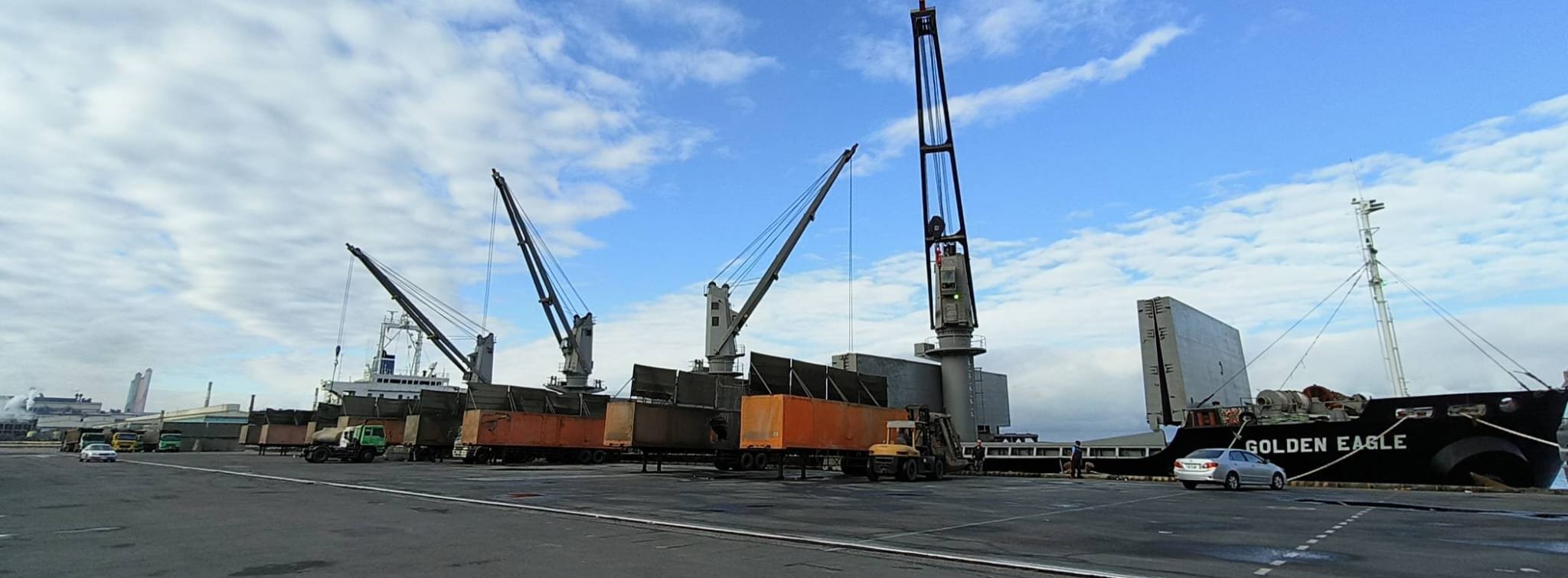
In the first 11 months of 2023, Vietnam exported more than 28.7 million tons of clinker and cement worth more than 1.2 billion USD, a slight increase of 0.4% in output but a decrease of 2.6% in turnover compared to with the same period.
According to statistics from the General Department of Customs, Vietnam's clinker and cement exports in November 2023 reached more than 2.5 million tons with a turnover of 101 million USD, down 6% in volume and down 8.8%. in value compared to the previous month.
Accumulated in the first 11 months of the year, the country has exported more than 28.7 million tons of clinker and cement, equivalent to more than 1.22 billion USD, a slight increase of 0.4% in output but a decrease of 2.6% in value. compared to the same period in 2022.
The average export price in the first 11 months of 2023 reached nearly 42.7 USD/ton, down nearly 3% over the same period.
Currently, Vietnam's three main cement export markets are the Philippines with a proportion of 27.4%; Bangladesh is 16.5%; Malaysia accounts for 5.1%.
Notably, clinker and cement exports to the Australian market during this period reached more than 57,000 tons with a turnover of 2.87 million USD, a sharp increase of 271% in volume and 232% in value compared to November. 2022.
After 11 months, Australia spent more than 23 million USD to import 470,000 tons of clinker and cement from Vietnam, an increase of 171% in volume and 153% in value over the same period. The average export price in 11 months reached nearly 50 USD/ton, down 6.7% over the same period in 2022.
According to the 2022 announcement of the US Geological Survey, Vietnam's cement output capacity will reach about 100 million tons, ranking third in the world. Specifically, the 5 countries with the largest cement production scale in the world include China, India, Vietnam, the US and Türkiye.
The cement industry is the most difficult in 100 years
In the domestic market, statistics from the Ministry of Construction show that in the first 11 months of 2023, cement consumption in the entire industry reached more than 80 million tons, down 12% compared to the same period in 2022. Accordingly, cement consumption in the domestic market is 52 million tons, down 16%; Export output reached nearly 29 million tons, down 29% over the same period.
The Ministry of Construction said that the sharp decrease in consumption output led to many cement factories having to stop operating some kiln lines, including some lines that had to be stopped for a long time.
The main reason is that the real estate market has been quiet for a long time since 2022, causing the construction of works and projects to decrease sharply, thereby leading to a low demand for cement for construction. .
In addition, the implementation progress of public investment and infrastructure construction projects is generally slower than planned, which is also the cause of output congestion in the production and supply chain of construction materials, in That's cement.
To overcome difficulties for the cement industry, the Ministry of Construction requested the Ministry of Transport to direct investors to increase the rate of using reinforced concrete viaducts for highway projects that are in the final stage. design, especially in areas with flood drainage requirements, weak soil areas and areas lacking road embankment materials such as the Mekong Delta.
Localities increase the use of cement concrete roads to build rural, mountainous roads and roads in frequently flooded areas.
At the same time, the Ministry of Construction also proposed to consider suspending the increase in clinker export tax (the main ingredient in cement products), reducing the clinker export tax rate to 0% until the end of 2025.
Via cafeland
8 materials associations called for help due to production difficulties. The Ministry of Construction proposed that the Government have many support measures such as reducing taxes and interest rates.
The Ministry of Construction has just consulted with the Ministries of Industry and Trade, Finance, and the State Bank on solutions to overcome difficulties for the materials industry before officially submitting them to the Prime Minister.
Previously, 8 associations included: Vietnam Construction Materials, Vietnam Cement, Vietnam Concrete, Vietnam Steel, Vietnam Construction Ceramics, Vietnam Construction Glass and Glass, Vietnam Roofing Sheets, The Vietnam Bridge and Road Science and Technology Association simultaneously called for help because output decreased and consumption was difficult.
According to the Ministry of Construction, this industry group annually contributes nearly 7% of Vietnam's GDP. The industry also plays an important role in infrastructure development, creating motivation for socio-economic development. However, in the face of a sharp decline in domestic real estate, slow implementation of public investment projects, and global economic instability, the industry's output has been affected both domestically and internationally.
Specifically, with cement, in the first 10 months of the year, the whole country consumed about 72.4 million tons, 4.35% lower than the same period last year; while exports decreased by 2%. The Ministry of Construction said that compared to normal, from the beginning of the year until now, domestic consumption has decreased by 13-15%. Many factories had to shut down to reduce inventory. Currently 8 lines, equivalent to 9% of the total cement production lines across the country, have stopped operating.
Steel production in 9 months also decreased by 21.6%, consumption decreased by nearly 20% compared to the same period last year. With ceramic tiles, in 10 months, output only reached about 47% of total design capacity, while consumption was 67% of production output. The amount of concrete also decreased by 14%.
To overcome difficulties for this industry, the Ministry of Construction proposed that the Ministry of Transport direct investors to increase the rate of using reinforced concrete viaducts for highway projects in the design stage, especially This is in areas with flood drainage requirements, weak soil areas and areas lacking road embankment materials such as the Mekong Delta.
Localities increase the use of cement concrete roads to build rural, mountainous roads and roads in frequently flooded areas.
The Ministry of Construction and the State Bank and localities will continue to deploy a credit package of 120,000 billion VND to develop social housing, worker housing, and renovate old apartments.
The Ministry also proposed to consider temporarily postponing the increase in clinker export tax (the main ingredient in cement products), reducing the clinker export tax rate to 0% until the end of 2025; Reduce loan interest rates for businesses producing construction materials (can reduce up to 2%) until the end of 2025; Continue to extend, do not charge interest on overdue debts and restructure loans to reduce difficulties for businesses.
In addition, under pressure from a sharp increase in imported products (for example, tiles), the Ministry of Construction proposed that the Ministry of Industry and Trade investigate anti-dumping on products from a number of countries to impose anti-dumping taxes. when necessary.
On the contrary, for businesses, the Ministry believes that it is necessary to improve competitiveness, proactively diversify products, and innovate in production.
Via vnexpress
By 2030, it is expected to issue new mining licenses to hundreds of mineral areas used to produce cement, paving stones, refractory materials and construction glass.
Develop commensurate with potential
Deputy Prime Minister Tran Hong Ha recently signed Decision No. 1626/QD-TTg approving the Plan for exploration, exploitation, processing and use of minerals as construction materials (construction materials) for the 2021 period -2030, vision to 2050.
Accordingly, the planning emphasizes the goal of sustainable development of exploration, exploitation and use of minerals as construction materials, commensurate with the potential, meeting the maximum demand for raw materials to produce materials for the economy. economic, minimizing negative impacts on the ecological environment and landscape.
Strive by 2030, the mining and processing industry of minerals used to make construction materials will become a modern industry, thoroughly applying information technology solutions and positioning technology in management and production. .
Applying science and technology, innovating modern mining and processing equipment associated with the circular economic model, responding to climate change, reducing greenhouse gas emissions; Meet domestic consumption and export needs for products with high added value and competitive advantage.
Investing in mineral exploitation and processing projects to make cement and marble become a key industry with sustainable development commensurate with the scale of minerals.
At the same time, stop construction material production activities that ineffectively use resources and pollute the environment; Prioritize the development of green materials and new environmentally friendly materials.
Encourage the formation and development of a number of large-scale, efficient and competitive mineral exploitation and processing enterprises and production of construction materials.
Issued hundreds of new mineral exploitation licenses
With the group of minerals for cement, in the period up to 2030, it is expected to issue new exploration licenses in 36 areas of limestone minerals, 46 areas of clay minerals and 31 areas of minerals as additives.
Continue to complete exploration and approval of reserves with 14 limestone mineral exploration projects and 19 clay mineral exploration projects; 9 projects to explore minerals as additives have been licensed.
Total exploration reserves in the planned areas are expected to reach more than 3.6 billion tons of limestone; more than 960 million tons of clay minerals and 500 million tons of various additives.
By 2030, it is expected to issue new mining licenses in 38 limestone mineral areas, 52 clay mineral areas and 34 areas of additive minerals.
Implementing 115 limestone mining projects with mining reserves of about 1.76 billion tons; 107 clay mining projects with reserves of about 350 million tons and 49 projects exploiting minerals as additives with reserves of about 188 million tons.
In the period 2031-2050, it is expected to issue new mining licenses in 44 limestone mineral areas, 39 clay mineral areas and 12 areas of additive minerals.
Implementing 154 limestone mining projects with mining reserves of about 4.8 billion tons; 135 clay mining projects with reserves of more than 1 billion tons and 59 mineral recovery projects with reserves of more than 478 million tons.
With the group of minerals used for making paving stones and handicrafts, by 2030, new mining licenses are expected to be issued in 163 areas; 32 quartz mineral areas.
Implementing 260 projects exploiting fine art paving stones with reserves of more than 64 million m3 and 32 projects exploiting quartz with reserves of 10.8 million tons.
With the group of minerals used for making ceramics and refractory materials, it is expected that new mining licenses will be issued in 67 kaolin and feldspar mineral areas, 4 white clay mineral areas, and 2 refractory clay mineral areas. .
Implemented 104 kaolin and feldspar mining projects with reserves of more than 135 million tons; 5 projects exploiting white clay with reserves of 1.9 million tons and 3 projects exploiting refractory clay with reserves of 5.8 million tons...
With the group of minerals used to make construction glass, new mining licenses are expected to be issued in 26 white sand mineral areas; implementing 40 white sand mining projects with reserves of 57.7 million tons.
Only export processed minerals that meet standards
Regarding planning for processing and use, strengthen research and application of recycling technology, reuse waste from industry and agriculture as raw materials and fuel for construction material production, reduce the use of mineral resources naturally, reducing environmental pollution.
Minerals used for construction materials are exploited to provide raw materials for processing and use projects according to the balance of market demand.
Mineral use must first prioritize domestic needs, ensuring a harmonious balance between exports and imports; Only export processed minerals that meet export standards according to regulations.
Investment in cement production projects must estimate the main raw material sources (limestone and clay) within the planning to ensure sufficient reserves and quality.
Investment in industrial lime production projects must estimate the main raw material sources (limestone, dolomite) within the planning to ensure sufficient reserves and quality.
Via cafeland
Package 4.6 to build runways, taxiways, and aprons at Long Thanh airport is expected to be constructed with cement concrete in January 2024, but currently the source of supplies and materials, especially sand and Stone is in short supply.
According to the representative of the contractor consortium (ACC Aviation Construction Corporation - Truong Son Construction Corporation - Vietnam Construction and Import-Export Joint Stock Corporation - Vietnam Construction Investment Development Joint Stock Company Nam - Cienco4 Group Joint Stock Company - 647 Aviation Construction Joint Stock Company), recently, contractors have carried out the construction of package 4.6 rolling in each segment. All human resources and vehicles are focused on excavation and earthworks to speed up progress. In addition, the contractor is preparing supplies and construction materials to carry out cement concrete construction, which is expected to begin in January 2024.
However, recently working with the working group of the Long Thanh International Airport project (State Capital Management Board), the representative of the contractor consortium said that currently, the source of supplies and construction materials, Especially sand and stone to serve the construction of package 4.6 are in short supply. Supplies are extremely limited. In addition, suppliers also show signs of competing with each other, raising the prices of these important supplies and materials, causing contractors to face many difficulties.
Faced with the issues raised, Mr. Nguyen Ngoc Canh, Vice Chairman of the Committee for Management of State Capital at Enterprises, said that recently, the whole country has simultaneously implemented large projects, so there has been a lack of locality. sources of construction materials, especially sand and stone. Therefore, the working group noted the lack of construction materials at the Long Thanh airport project to report to the Steering Committee to find solutions to resolve difficulties and problems. Regarding the supply of materials for construction, Mr. Canh suggested that Dong Nai province consider taking advantage of material mines to serve the project.
The consortium of contractors executing package 4.6 recommends that the investor allow the addition of new sources of supplies and materials in addition to the sources that the consortium of contractors has proposed in the bid documents to ensure the source of supplies. construction service supply.
Regarding this issue, according to Deputy Director of the Department of Natural Resources and Environment of Dong Nai province Nguyen Ngoc Hung, to meet the need for construction materials to serve projects, especially the Long Thanh Airport project, in recent times, You have sent a document requesting localities to search and plan additional material exploitation sites so that further procedures can be implemented and progress to exploitation as soon as possible in the near future.
Via Tien Phong
NHT TRADING INVESTMENT DEVELOPMENT CO., LTD.
NHT COMPANY: 10 YEARS OF GROWTH, 20+ YEARS OF EXPERTISE NHT Corporation, with just 10 years of development building upon over 20 years of experience in the trading of construction materials and energy. We export cement and clinker to numerous key countries, including the USA, Canada, China, Taiwan, Bangladesh, Cambodia, Laos, the Philippines, Cuba, and various nations in South America, import gypsum (from Thailand and Oman) to supply cement plants in Vietnam. We also supply thermal coal for thermal power plants (such as Vĩnh Tân, Duyên Hải, Sông Hậu) and for cement plants, and provide transportation services for coal, clinker, and stone.
CONTACT INFORMATION
operation@nhtcorp.com.vn
(+84)28 7300 6919
150 Tran Nao Street, An Khanh Ward, Hochiminh City, Vietnam.